Commercial guide
The difference between private label, OEM and white label manufacturing, which one your program actually needs, and what each requires you to supply.
What is the difference between private label and OEM apparel manufacturing?
In OEM manufacturing the buyer supplies the design and specification and the manufacturer produces to it. The product is the buyer's, made to their document. In private label manufacturing the buyer applies their own brand to a garment, which may be their own design or a manufacturer's existing article. White label is the narrower case where a manufacturer's standard product is rebranded with minimal change. Most uniform and workwear programs are OEM in practice, because the buyer specifies the garment and puts their own brand on it.
Which model fits your program
| Attribute | OEM | Private label | White label |
|---|---|---|---|
| Who designs the garment | Buyer | Buyer or manufacturer | Manufacturer |
| Specification supplied by | Buyer | Buyer, or adapted from an existing article | Manufacturer |
| Branding | Buyer's | Buyer's | Buyer's |
| Development effort | Highest | Moderate | Lowest |
| Control over construction | Full | Partial to full | Limited |
| Typical use | Uniform and workwear programs | Brand ranges and retail programs | Fast, low-differentiation products |
What most buyers actually need
Most uniform, workwear and program buyers describe what they want as private label, and are describing OEM. They have a garment that has to fit a role, survive a laundering cycle and carry their brand, which means the specification is theirs, even if it started as an adaptation of something they already buy.
The distinction matters commercially because it determines where the development work sits. In OEM, the buyer's specification is the contract; every question it leaves open becomes a cost assumption. In a genuine white label arrangement, the manufacturer's article is the reference and the buyer's control is limited to what the article already offers.
AHM works OEM: the specification comes from the buyer, and where it is incomplete we resolve it with you rather than substituting our own preference silently.
What you supply for a private label program
- Specification
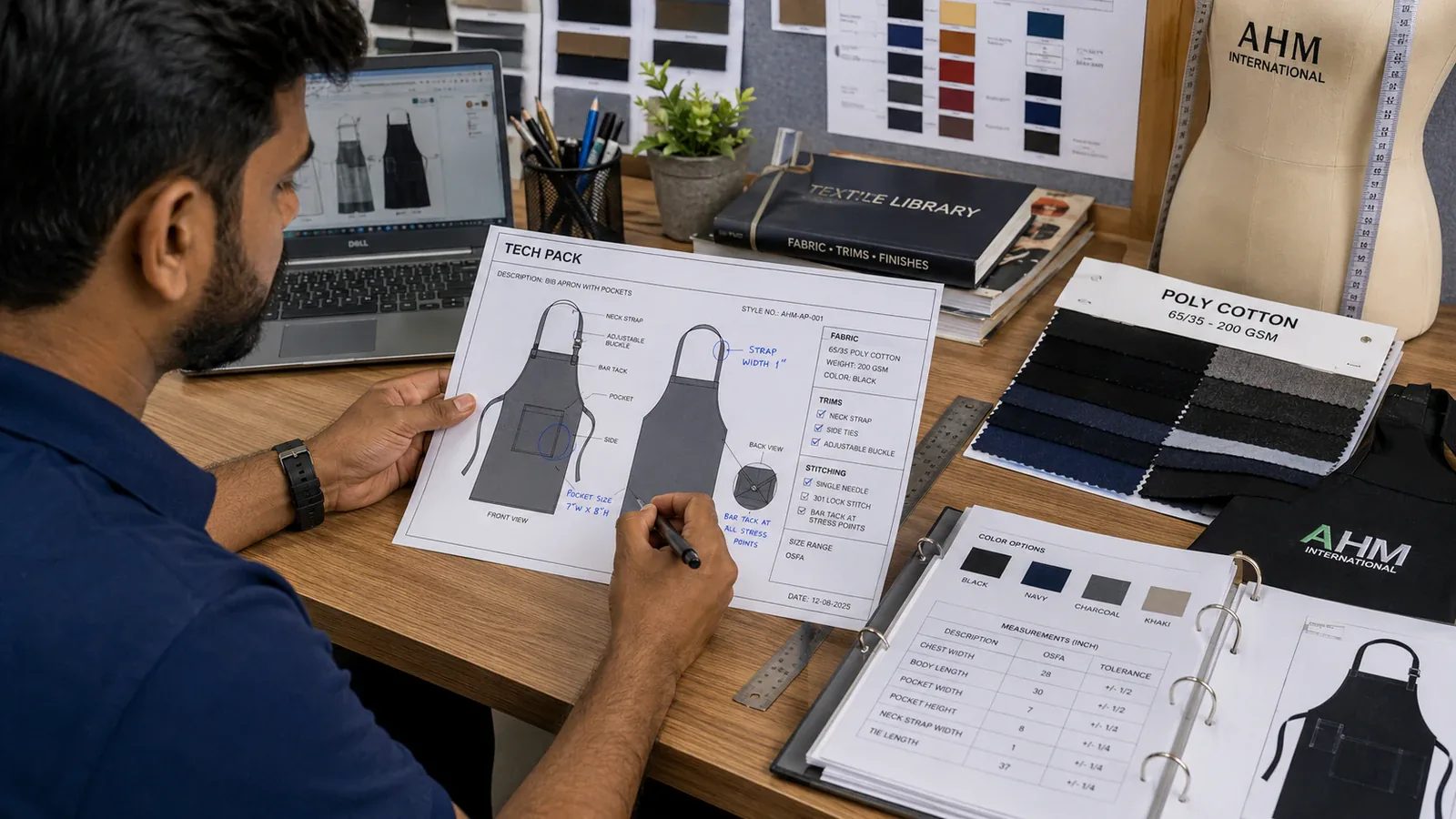
- Tech pack, reference garment, sketch or written requirement.
- Brand assets
- Vector artwork for embroidery and print, and thread or ink colour references.
- Labelling
- Main label, care label, size label and country-of-origin requirements, with artwork.
- Packing
- Polybag, folding, ratio and carton marking requirements.
- Compliance requirements
- Any market-specific labelling your import process requires. You approve the final wording.
How a private label program is built
- 01
Article definition
The garment is specified. Either from your tech pack or by documenting a reference garment you already buy.
- 02
Material selection
Fabric and trims matched to the requirement, with commercial alternatives presented.
- 03
Branding specification
Labels, decoration and packaging specified together, since all three carry the brand.
- 04
Sampling and approval
Proto and fit samples against written comments, ending in a sealed reference.
- 05
Production and inspection
Bulk to the approved construction, inspected against your standard.
- 06
Packing and FOB dispatch
Packed and marked to your instruction, then delivered on board at Port Qasim.
On confidentiality
Tech packs, designs and commercial terms shared with AHM are treated as confidential. This site publishes no customer name, and the single case study shown is anonymised with the customer's identity absent from the underlying data rather than merely hidden in the page.
Buyer questions
Reviewed by
AHM International product development team
Last reviewed August 2026
AHM works to buyer specification rather than selling a catalogue. Where you do not have a specification, we can document a reference garment you already buy and develop from that, which gives you a garment you control rather than one you rent.
Yes. Main labels, care labels, size labels, printed neck labels, hangtags and packaging are sourced and applied to your artwork and specification.
Where the specification and design come from you, they remain yours. Where we develop a pattern from your reference garment for your program, it is developed for your program.
It depends on the article, the fabric and the colour count. Fabric mill minimums are usually the binding constraint rather than the stitching. It is confirmed once those three are known.
One style is enough to evaluate a supplier. We review it and come back on construction, materials, decoration and commercial FOB costing.
Explore next
Explore next
Product development
How a specification becomes an executable manufacturing document.
Apparel manufacturer in Pakistan
What to send, and what is verified versus per-project.
Product range
Twelve apparel families manufactured to buyer specification.
Embroidery and decoration
Digitising per substrate and sew-out approval.
Materials
Construction families, typical weights, finishes and applications.
Request a quote
Send a specification and get costed against it.