Commercial guide
What drives metres per garment, why a GSM number cannot answer it, and which inputs belong in a quotation request if you want a comparable fabric line.
In short
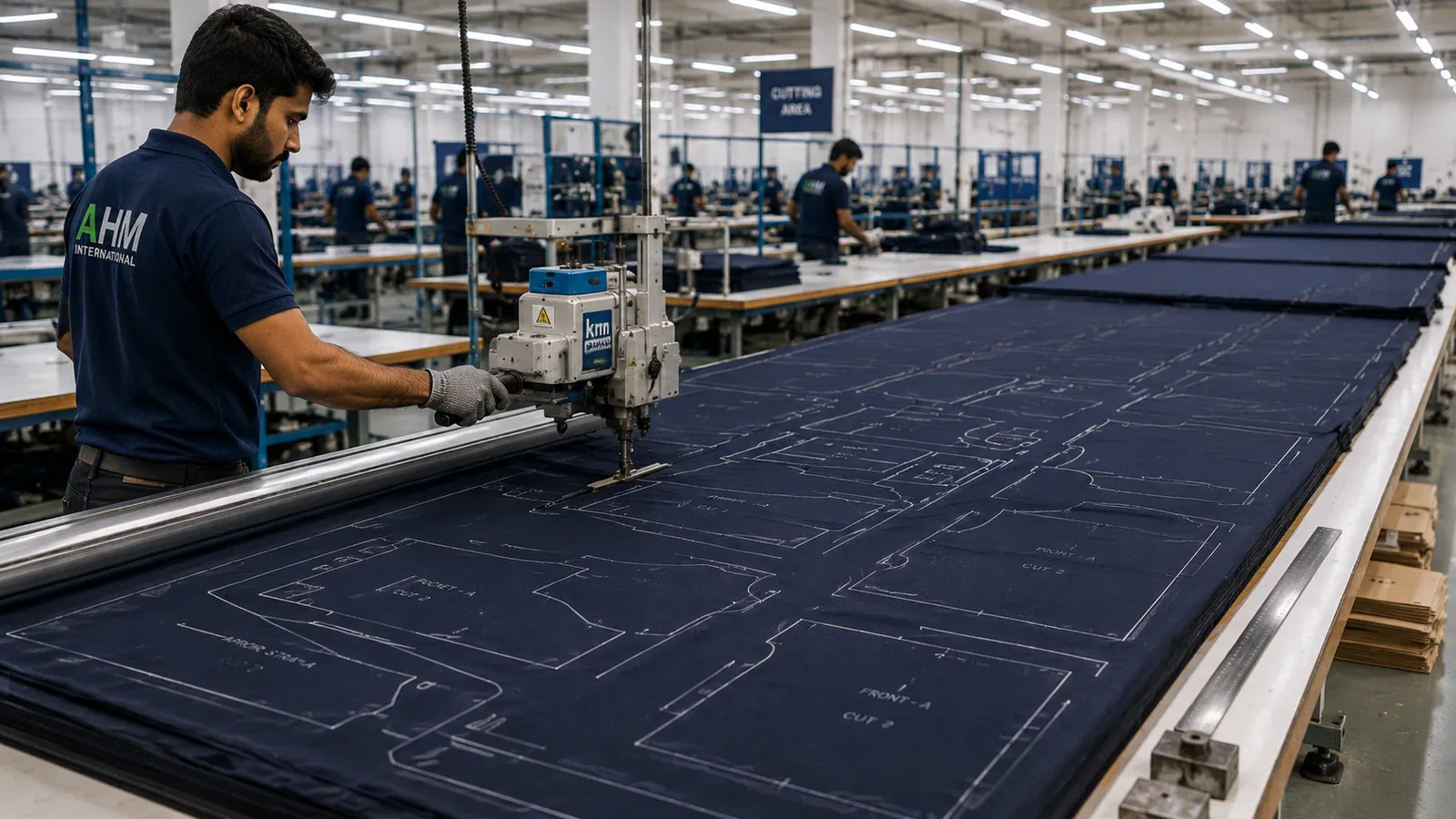
Fabric consumption is decided by the marker — the nested layout of pattern pieces across usable fabric width — not by fabric weight alone. Size ratio, garment design, nap or one-way prints, shrinkage allowance and seam waste all move the number. A rule of thumb from GSM invents a cost line someone will later treat as a fact.
6 min read
Reviewed by AHM International product development team
Last reviewed August 2026
The question buyers most want answered
“How many metres per piece?” is the right commercial question and the wrong calculator input. Weight tells you mass per area. Consumption asks how much area the pattern needs once pieces are nested on a roll of a given usable width.
That is why AHM’s public GSM tool converts and weighs fabric, and deliberately does not invent a consumption mode. Publishing a shortcut would look helpful and would mis-cost programs the first time the marker changed.
A honest quotation builds consumption from the tech pack or a reference garment, then attaches fabric price to that meterage — with waste factors the buyer can see rather than hide.
What actually moves metres per garment
- Usable width
- Full mill width is not cuttable width. Selvedge and needle lines reduce what the marker can use; comparing mills requires the same basis.
- Size ratio
- A run heavy on XL consumes differently from a run heavy on S. Quote the ratio you will order.
- Pattern and design
- Pockets, yokes, plackets and panels add pieces. A “simple tee” and a “uniform tee with badge patch” are not the same marker.
- Nap and direction
- Brushed fabrics, directional prints and some twills force one-way nesting and raise consumption.
- Shrinkage allowance
- If the pattern is cut larger to survive wash, the marker grows before a single garment is sewn.
- Marker efficiency
- How tightly pieces nest. Efficiency is a result of the pattern and the width, not a moral quality of the factory.
Inputs that make fabric lines comparable
| Send this | Why quotations diverge without it |
|---|---|
| Tech pack or reference garment | Without a pattern, every factory invents a different shape |
| Size range and ratio | Average size assumptions hide XL cost |
| Fabric width / usable width | Price per metre on different widths is not comparable |
| Composition, GSM, construction | Fabric cost and behaviour change with each |
| Shrinkage or wash expectation | Allowance may be in the pattern or left for the factory to assume |
No public consumption calculator on this site
On purpose. Consumption comes from the marker. Any website that multiplies GSM into a “metres per polo” figure is guessing. Send the style; we return a commercial FOB built against the specification, including a fabric line you can audit.
How this sits next to FOB
Fabric is usually the largest material line in an FOB build. Saving five centimetres of average consumption on a large program is real money; saving it by narrowing the garment without telling the buyer is not a saving — it is a different product.
When you compare quotations, ask each supplier what marker assumptions and width they used. Two FOB prices with unspoken consumption differences are not two prices for the same garment.
Related questions
No. GSM is mass per area. Consumption is area required by the nested pattern. You need both geometry and width — which means a pattern or a measured reference garment.
Extra pieces need space on the marker, and small parts often nest poorly. Decoration and patches can also force placement that blocks efficient nesting.
You can, and it is a useful discussion number — but only alongside the same width, ratio and pattern. Efficiency without those inputs is not comparable between suppliers.
Send one specification and we will apply exactly this thinking to your style. Construction, materials and commercial FOB costing.
Explore next